

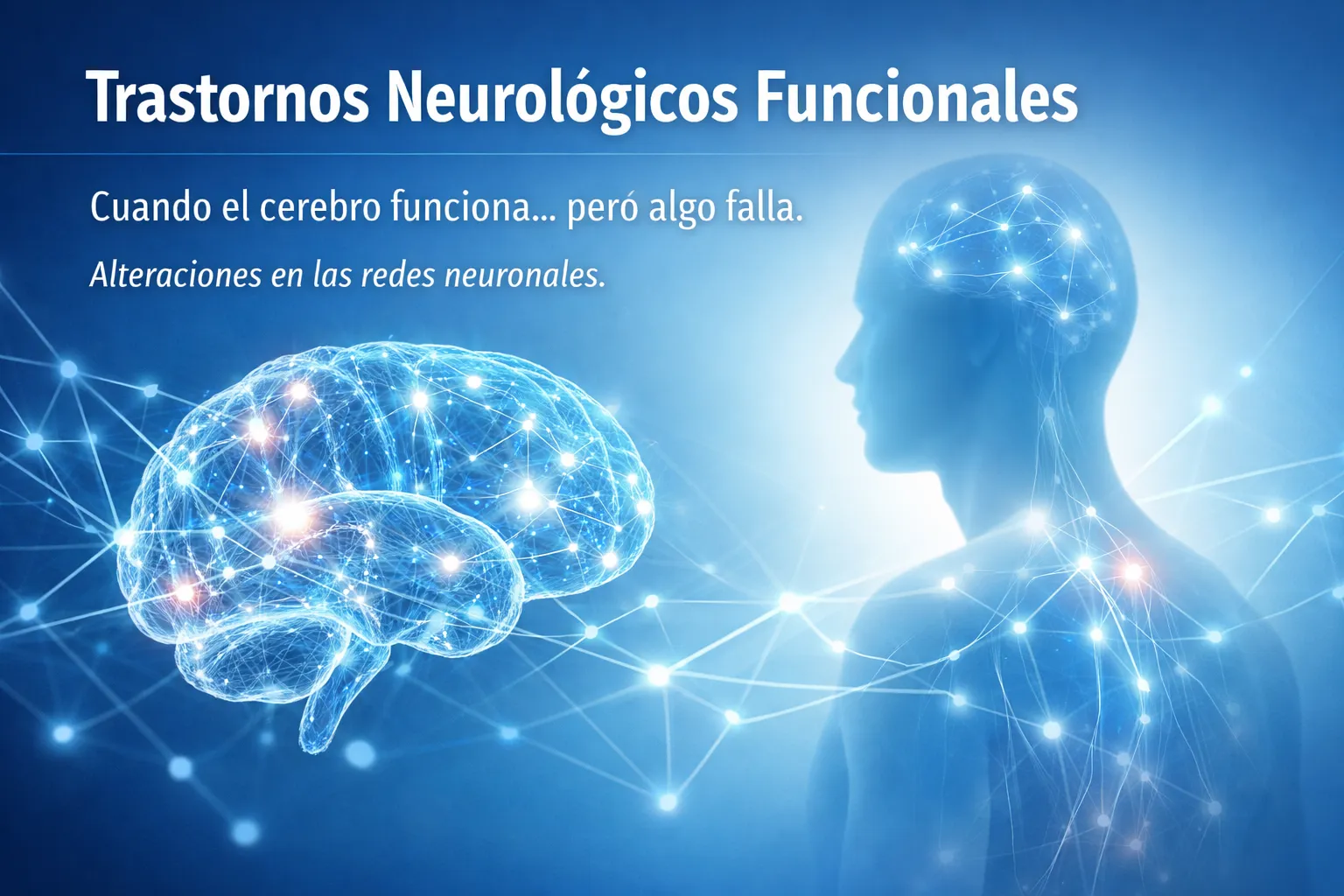
There is a group of conditions in clinical practice that confused doctors and patients alike for many years. People present with genuine neurological symptoms, such as weakness, tremor, seizures or cognitive difficulty, yet medical tests show no clear structural lesion in the brain.
Today these conditions are known as functional neurological disorders (FND).
Far from being an imaginary illness, we now know that they involve changes in how brain networks function, affecting the way the brain controls movement, sensation or awareness.
What is a functional neurological disorder?
Functional neurological disorders are conditions in which a person has genuine neurological symptoms, such as weakness, tremor or seizures, that are not explained by a structural lesion of the nervous system but by a disturbance in how brain networks operate.
In other words:
- The brain is not structurally damaged
- But the networks that control certain functions are not working correctly
This is why terms such as "functional brain disorder" are used. These conditions sit at the intersection of neurology and psychiatry, which explains why they have historically been so poorly understood.
Are they actually common?
More common than people think. Functional neurological disorders account for roughly 5% to 10% of neurology consultations, making them one of the most frequent reasons for referral after headache.
Incidence is estimated at around 10 to 15 cases per 100,000 people per year. In addition:
- they are more frequent in women
- they usually appear between the ages of 20 and 40
- but they can occur at any age
The most common symptoms
Movement disturbances
- weakness in a limb
- difficulty walking
- tremor
- involuntary movements
Functional seizures These resemble epileptic seizures but show no epileptic activity on an electroencephalogram.
Sensory changes
- tingling
- loss of sensation
- blurred vision or visual loss
Cognitive problems
- difficulty concentrating
- memory problems
- a sense of mental fog
These symptoms can fluctuate in intensity and often get worse with stress or tiredness.
What is happening in the brain?
Recent research shows that functional neurological disorders are not simply psychological. Neuroimaging studies have identified changes in brain networks involved in:
- motor control
- emotional processing
- bodily perception
- attention
- the sense of control over one's own actions, known as self-agency
The regions implicated include the amygdala, the cingulate cortex, the insula, the prefrontal cortex and sensorimotor networks.
In some patients there is also greater connectivity between emotional and motor systems, which may explain why emotions influence physical symptoms.
Why do they appear?
There is no single cause. The current understanding is that they arise from an interaction of several factors:
Biological factors
- changes in neurotransmitters
- changes in brain networks
- changes in neuroplasticity
Psychological factors
- intense stress
- emotional conflict
- early adverse experiences
That said, not every patient has a history of trauma.
Medical factors Some neurological conditions or injuries can act as triggers: migraine, epilepsy, head injury, infection.
An important point: the symptoms are real
One of the biggest problems people with functional neurological disorders face is stigma. For many years these symptoms were thought to be feigned or exaggerated.
We now know that is not the case. Clinical and neurophysiological studies show that the symptoms are genuine and reflect changes in how the brain is functioning, even though no structural lesion is visible.
A new approach in medicine
The approach has changed significantly. Diagnosis today no longer rests solely on excluding other conditions but on identifying positive clinical signs characteristic of these disorders.
This allows for:
- earlier diagnosis
- fewer unnecessary tests
- better therapeutic direction
A final thought
Functional neurological disorders are a clear example of how deeply the brain and the body are connected. Understanding them means drawing together neurology, psychology, neuroscience and integrative medicine.
Far from being mysterious, we now know they reflect real changes in the networks that coordinate our brain functions. Recognizing and understanding them is the first step towards treatments that are both more effective and more humane.
References
Hallett, M., Aybek, S., Dworetzky, B. A., McWhirter, L., Staab, J., & Stone, J. (2022). Functional neurological disorder: New phenotypes, common mechanisms. The Lancet Neurology, 21(6), 537–550.
Mavroudis, I., Kazis, D., Kamal, F. Z., Gurzu, I. L., Ciobica, A., Pădurariu, M., Novac, B., & Iordache, A. (2024). Understanding functional neurological disorder: Recent insights and diagnostic challenges. International Journal of Molecular Sciences, 25(8), 4470.
Perjoc, R. S., Roza, E., Vladacenco, O. A., Teleanu, D. M., Neacsu, R., & Teleanu, R. I. (2023). Functional neurological disorder – old problem, new perspective. International Journal of Environmental Research and Public Health, 20, 1099.