

Feeling safe is part of the treatment
Many patients arrive with symptoms: chronic pain, anxiety, fatigue, digestive problems, insomnia or depression.
In many cases, though, the symptom is not the cause. It is the expression of something deeper.
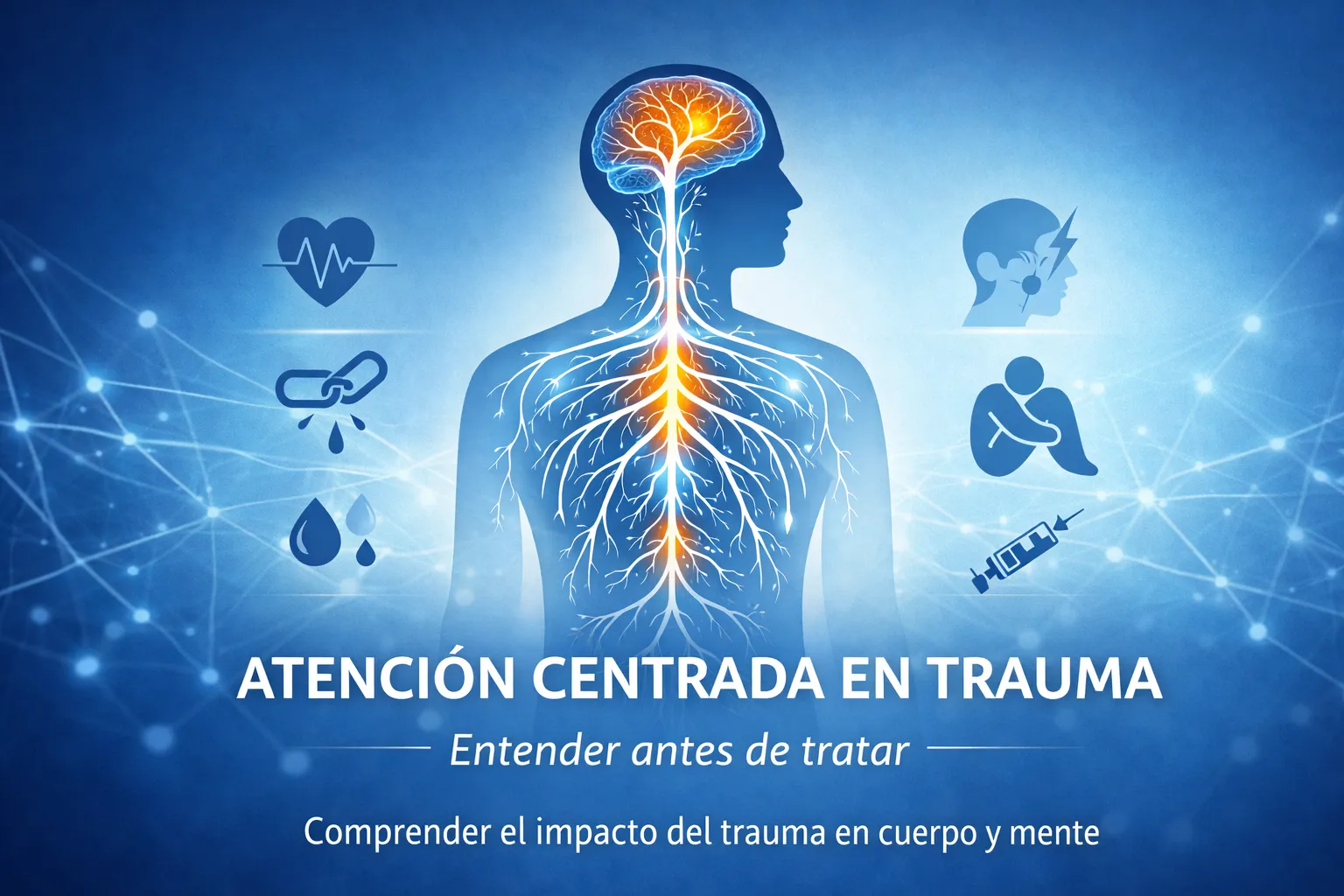
We now know that adverse experiences, particularly in childhood, can have lasting effects on the body and the brain, raising inflammation, altering the nervous system and making a range of physical and mental illnesses more likely.
Put another way:
We are not always treating a disease. Often we are watching a person's history express itself through their body.
What is trauma-informed care?
Trauma-informed care is not a specific therapy. It is a way of understanding the patient.
It involves two things above all:
- Recognizing that trauma is common and has lasting effects
- Adapting care so that it does no harm and supports recovery
This approach changes the central question. Instead of "What does this patient have?" or "What is wrong with you?", it asks "What has happened to this person?"
Trauma-informed care is a way of delivering care that recognizes the impact of adverse life experiences and works to avoid re-traumatization, building safety, trust and collaboration.
Why does it matter so much?
Because untreated trauma can:
- Raise the risk of cardiovascular, metabolic and autoimmune disease
- Contribute to anxiety, depression and addiction
- Produce chronic pain and persistent fatigue
- Disrupt emotional and bodily regulation
And there is something else, which matters a great deal: the health system itself can unintentionally make a patient worse. Many medical procedures that are invasive, impersonal or authoritarian can reactivate earlier traumatic experiences and cause re-traumatization.
The five principles of trauma-informed care
1. Recognize and validate the experience
Listening to the patient's story changes everything. This is not about going into traumatic detail. It is about:
- Recognizing that their history matters
- Understanding that their symptoms make sense
Many present-day behaviors began as survival strategies.
2. Safety, physical and emotional
The patient needs to feel they are in a safe space:
- Appointments that are predictable
- Respectful treatment
- No judgment and no authoritarian stance
Without safety, there is no therapeutic process.
3. Trust
The therapeutic relationship is central to this. It means:
- Explaining clearly what is being done
- Respecting boundaries
- Not pressuring the patient
Trust is built. It cannot be demanded.
4. Choice and collaboration
The patient stops being passive and becomes an active participant:
- Decisions are made together with the clinician
- The treatment is understood
- Saying "no" is an option
This breaks the pattern of learned helplessness.
5. Build on strengths and resilience
The focus shifts from pathology to capacity, from weakness to adaptation. The patient is not only someone who was harmed. They are also someone who survived.
Trauma and the body: what we see at IDENTA
We see this every day at IDENTA. Patients with:
- Chronic fatigue
- Persistent pain
- Functional neurological symptoms
- Anxiety expressed through the body
- Central sensitization syndrome
When we look more closely, a history of chronic stress, trauma or dysregulation often appears.
This does not mean that "it is all psychological". It means something far more complex: body and mind are dysregulated as a single system.
How we approach it at IDENTA
1. Integrated assessment
We do not look only at symptoms. We assess:
- Medical factors: metabolic, inflammatory, hormonal
- Regulation of the nervous system
- Life history and stress
2. A clear explanation for the patient
One point matters more than most: "Your system is dysregulated, not damaged." That reframing changes the whole experience of being ill.
3. Structured intervention (IBI-IDENTA)
We work on:
- Emotional and bodily regulation
- Cognitive and narrative integration
- Graded exposure to symptoms
- Regaining a sense of control
4. Neurostimulation, where indicated
We use tools such as non-invasive brain stimulation and neurophysiological regulation. Always as a complement, never as a substitute.
5. Measuring outcomes
We do not work blind. We measure anxiety, depression, fatigue and function.
A change of paradigm
Trauma-informed care is not just a technique. It is a different way of seeing medicine: more humane, more precise, more thorough. And, as it turns out, more scientific.
Because it recognizes something fundamental:
The patient's history is part of their physiology.
If you have had symptoms for a long time that do not improve, or you feel that nobody has managed to understand what is happening to you, it may not be that "there is nothing wrong". It may be that your full history has not yet been understood.
That is precisely where we work at IDENTA: at the point where the body, the mind and the life story meet.
Written by Dr. Alejandro Luque Hernández
References
Purkey, E., Patel, R., & Phillips, S. P. (2018). Trauma-informed care: Better care for everyone. Canadian Family Physician, 64(3), 170–172.
Butler, L. D., Critelli, F. M., & Rinfrette, E. S. Trauma-informed care and mental health. Directions in Psychiatry.