

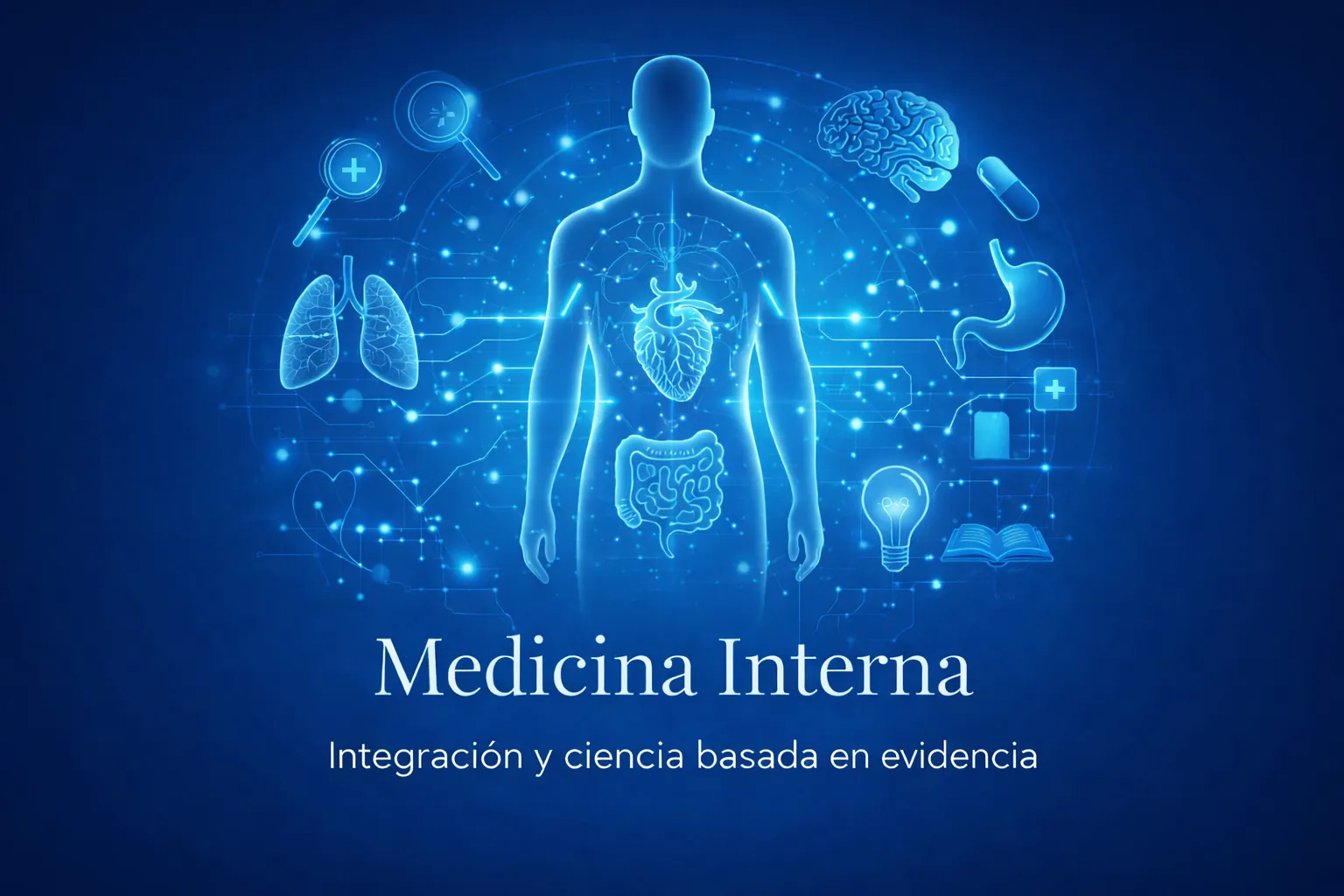
In a health system increasingly fragmented by subspecialties, internal medicine is the discipline that still looks at the whole patient.
The internist is not confined to one organ or one isolated system. Their field is the overall understanding of the adult patient, drawing together physiology, pathology, pharmacology, scientific evidence and complex clinical reasoning.
Internal medicine is, by definition, integration.
What does an internist do?
The internist specializes in the care of adults with illnesses that are:
- Chronic and complex
- Multisystem
- Difficult to diagnose
- Accompanied by several comorbidities
- In need of coordinated treatment
The internist also plays a central part in:
- Integrated diagnostic evaluation
- Risk stratification
- Rational medication management
- Secondary prevention
- Complex clinical decision-making
This does not replace other specialties. It integrates them.
Integrative clinical reasoning
One of the defining features of internal medicine is structured clinical reasoning.
The internist assesses:
- Symptoms within networks of pathophysiology.
- Interactions between systems: endocrine, cardiovascular, immune, metabolic.
- The effect of treatments across multiple organs.
- Risk and benefit in patients on many medications at once.
Being able to integrate this range of clinical information reduces diagnostic error and improves therapeutic decisions.
Internal medicine and evidence-based practice
Modern internal medicine rests on:
- International clinical guidelines.
- Controlled clinical trials.
- Meta-analyses.
- Validated risk stratification.
The internist does not work from intuition alone but from a critical reading of the best available evidence, applied to the individual patient's context.
This balance between scientific evidence and clinical judgment is one of the ethical foundations of the specialty.
More than isolated diseases
Many patients do not present with a single medical problem but with combinations such as:
- Diabetes with hypertension and dyslipidemia
- Autoimmune disease with a metabolic disorder
- Chronic pain with anxiety
- Persistent symptoms with no clear structural explanation
Internal medicine makes it possible to understand these interactions without breaking the patient into parts.
The goal is not to treat organs. It is to understand systems.
The value of integration
In clinical settings where fragmentation can produce disconnected treatments, duplicated tests or unnecessary polypharmacy, the internist works as the point of integration.
That role is not only therapeutic. It is organizational: someone has to hold the care together.
Internal medicine represents a way of thinking about medicine that is broad, analytical, structured and grounded in evidence.
Integration is not a recent interdisciplinary fashion. It is the historical essence of internal medicine.
Understanding the adult patient in their biological, clinical and contextual complexity remains one of the most demanding challenges in contemporary medical practice.
References
American College of Physicians. (2019). Internal medicine: The specialty of adult medicine. ACP.
Kelley, W. N., & Firestein, G. S. (2018). Kelley and Firestein's textbook of rheumatology (10th ed.). Elsevier.
Loscalzo, J., Fauci, A. S., Kasper, D. L., Hauser, S. L., Longo, D. L., & Jameson, J. L. (2022). Harrison's principles of internal medicine (21st ed.). McGraw-Hill.
Montgomery, K. (2006). How doctors think: Clinical judgment and the practice of medicine. Oxford University Press.
Norman, G., & Eva, K. (2010). Diagnostic error and clinical reasoning. Medical Education, 44(1), 94–100.
Sox, H. C., Higgins, M. C., & Owens, D. K. (2013). Medical decision making. Wiley-Blackwell.